The Model 5422 Dante Intercom Audio Engine is a high-performance, cost-effective, and flexible solution for creating party-line (PL) intercom circuits when used with Dante-compatible products. These include the Studio Technologies' range of 1-, 2- and 4-channel intercom beltpacks. The Model 5422 will also prove valuable in a variety of other general-audio and broadcast-related mixing, IFB (talent cueing), and interfacing applications. The unit is suitable for use in fixed and mobile broadcast facilities, post-production studios, commercial and educational theater environments, and entertainment applications. Only power and one or two Ethernet network connections are required for the Model 5422 to provide a powerful resource in a variety of Dante applications. The Model 5422 is available in two versions – one with 32 input and output channels and the other with 64 input and output channels.
The unit's dual Gigabit Ethernet (GigE) network interfaces support Redundant Dante operation. And to meet the latest interoperability standard the Model 5422's Dante implementation meets the requirements of AES67. Support for the Dante Domain Manager™ (DDM) software application is also provided. An integral web server allows fast and flexible configuration of the unit's audio, networking, and Dante performance. Front-panel indicators, a graphics display, and pushbutton switches provide personnel with direct access to key operating parameters. The Model 5422 can be powered by 100-240 V, 50/60 Hz mains or a source of 12 volts DC. The lightweight enclosure mounts in one space (1U) of a standard 19-inch rack.
Applications
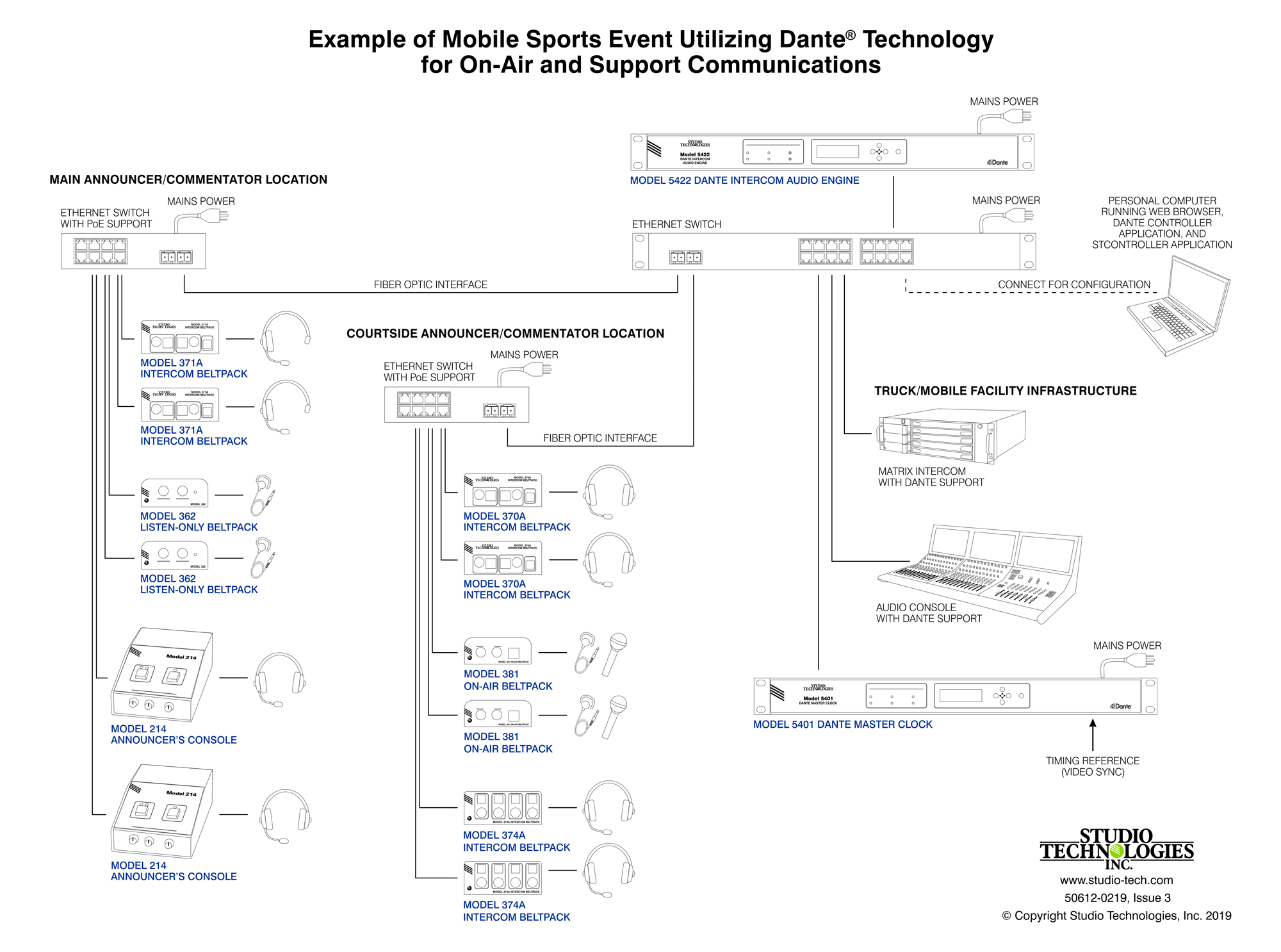
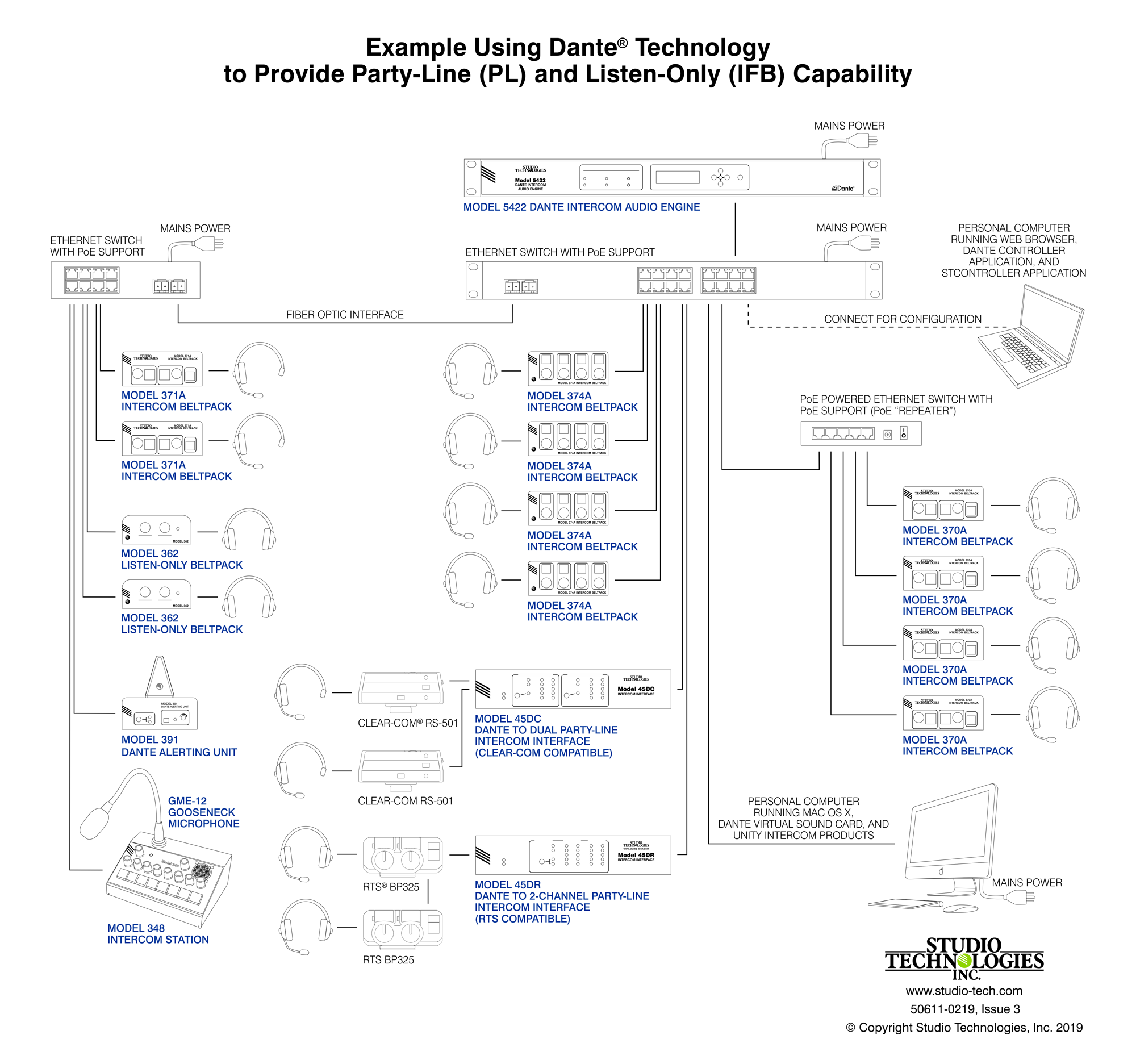
The Model 5422 is compatible with many Dante-compliant devices including the extensive range of intercom beltpacks from Studio Technologies. These include the single-channel/dual-listen Model 372A and Model 373A, the 2-channel Model 370A and Model 371A, and the 4-channel Model 374A. The Model 5422 will also function directly with other Dante-supporting devices such as the Model 348 Intercom Station and Model 391 Dante Alerting Unit. In addition, the Model 5422 can function with matrix intercom systems, audio consoles, and wireless intercom base stations.
Pro Audio Quality and Auto Mix
The Model 5422 supports 24-bit, 48 kHz sampling rate digital audio signals that interface using Dante. The unit's audio circuitry was designed to meet the demands of professional audio applications, far exceeding the sonic quality of "typical" intercom products. All audio processing is performed using high-speed 32-bit programmable logic. This ensures that the audio performance is excellent, providing the expected benefits of minimal distortion, low noise, high headroom, flat frequency response, and extremely low latency.
The Model 5422's Auto Mix function utilizes a sophisticated FPGA-based algorithm to provide enhanced audio intelligibility. This feature is unique to party-line (PL) intercom applications and offers user's the opportunity to obtain the absolutely finest audio performance. Studio Technologies is confident that the Model 5422's Auto Mix capability will meet or exceed the automatic mixer performance of virtually all other hardware- or software-based devices.
Two Versions
Two versions of the Model 5422 are available. The Model 5422-01 provides one 32-channel audio engine. The Model 5422-02 provides two 32-channel audio engines for a total of 64 input and output channels. The size and scope of a specific application will dictate which Model 5422 version is applicable. The term "audio engine" was selected to describe a set of audio input, processing, routing, and output resources that can be configured to support specific intercom, talent-cueing, and audio routing and control functions. Unlike general-purpose digital matrix devices, the Model 5422 is optimized to allow direct support for these special broadcast and general intercom applications.
Group Configuration
Configuration choices select how each 32-channel audio engine is segmented, named, and optimized for how the associated audio signals are processed.
Group Size
The ability to segment a 32-channel audio engine into multiple groups allows efficient use of the Model 5422's Dante channels. As all Dante intercom beltpacks are essentially 4-wire devices (having independent receiver (input) and transmitter (output) channels) "virtual" (simulated) party-line functionality must be created within the Model 5422's audio engines. This requires that the maximum number of participants (users) on any one "party-line" be defined.
The 32 channels offered by an audio engine can be configured into what are called groups. Simple configuration choices in the Model 5422's menu pages allow the number of groups and their sizes to be selected. Groups can range in size from 32 channels (a complete audio engine being used for a single group) to having just four channels. The size of a group will dictate how many devices and associated users can be part of any one party-line or how many channels will be impacted by a processing setting for a specific group. Ten choices allow a wide range of group configurations to be selected. The default setting for each audio engine is to have four 8-channel groups. This leads to the Model 5422-01 having four 8-channel groups and the Model 5422-02 having eight 8-channel groups. Refer to the Specifications section for a detailed list of the group sizes that are available.
Group Names
Each group can be assigned a unique name. These names would typically reflect how the specific groups are going to be utilized. Names such as Camera PL, Lighting, Pyro, or Engineering would be typically used in broadcast-or live-event-oriented intercom applications. The configured names are automatically used by the Model 5422's Dante Interface, providing clarity when routing Dante channels using applications such as Dante Controller. Each group name can be a combination of up to 13 alpha or numeric characters. Channel numbers are automatically appended to the entered names to provide identification of the specific channels within the Dante environment. A name of up to 13 additional characters can also be added to each specific channel, providing further details about an application.
Group Operating Modes
While the primary application for the Model 5422 is to create party-line (PL) intercom circuits, each group can be independently configured from among seven operating modes: Party-Line w/Auto Mix, Party-Line, Summing Bus w/Auto Mix, Summing Bus, IFB, Audio Switching, and Pass-Thru.
Party-Line
When a group is set for Party-Line operation the Model 5422's audio processing circuitry creates a series of independent "mix-minus" outputs, one for each channel in the group. These specialized outputs allow each intercom user assigned to that specific group (a "party-line") to hear all members of that group except for themselves. (This is the origin of the term mix-minus and indicates a mix of all sources but themselves.) By each user receiving a mix-minus signal precise control of each user's sidetone audio level and overall audio quality can be maintained. The Auto Mix function can be enabled for use with the Party-Line mode and will offer Model 5422 users with a level of audio performance that is unique among intercom applications.
Summing Bus
When a group is configured for Summing Bus operation audio sources assigned to the group's input channels are mixed (summed or combined). The resulting mix is routed to all the output channels associated with that group. While essentially providing a "unity gain" mixer function, using the Model 5422's web menu pages the level of each input and output channel can be adjusted over a ±20 dB range. The Summing Bus mode can be useful for general-purpose audio mixing applications where multiple Dante channels need to be combined. The Auto Mix function can also be enabled for use with the Summing Bus mode. This will allow a Model 5422 to be useful in applications well beyond broadcast intercom. This may prove especially useful in audio applications that require combining many voice sources. Press conferences, sports interview configurations, and government meeting situations may all benefit from this capability.
IFB
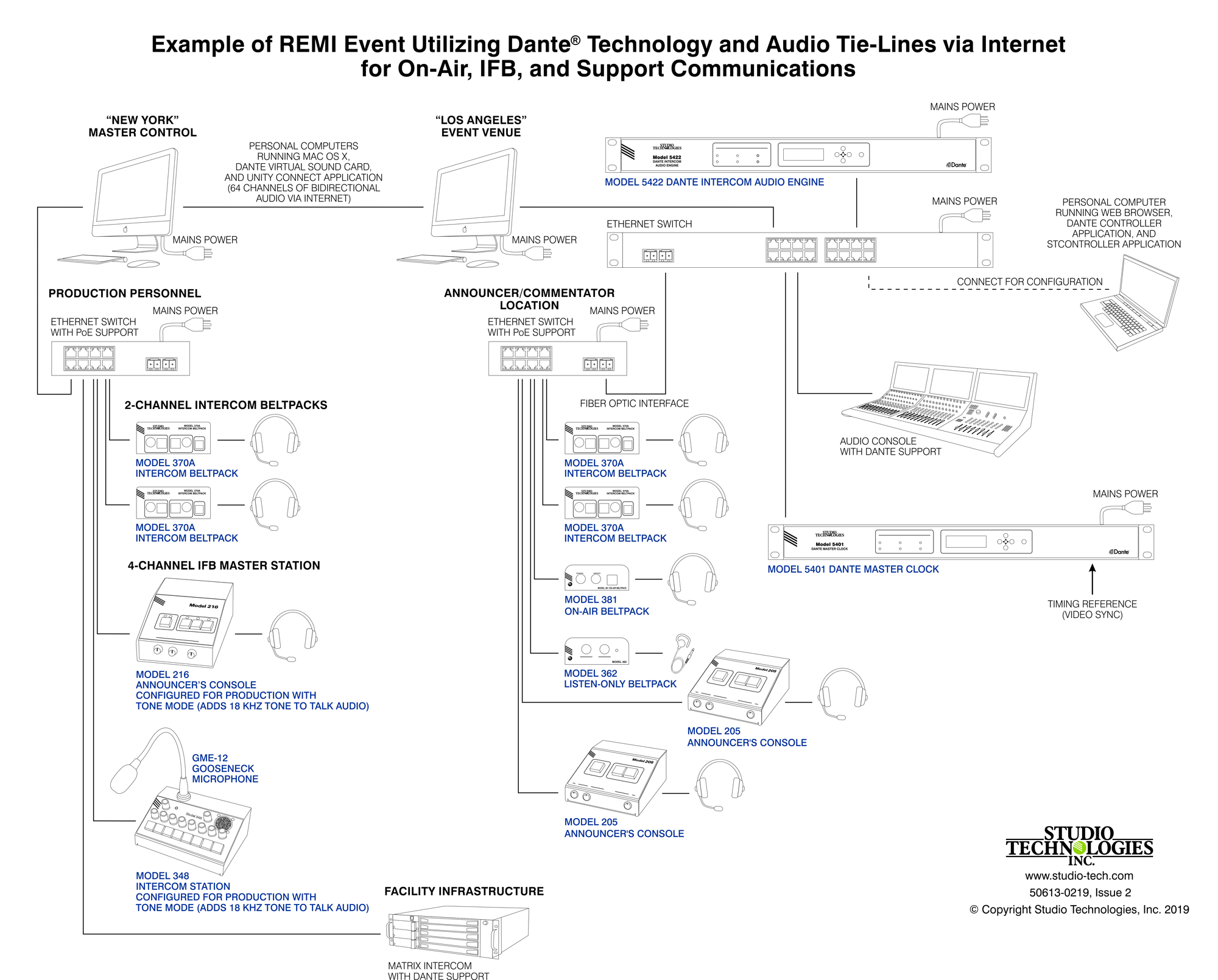
The IFB mode is specifically included for productions that utilize the Remote Integration (REMI) or At-Home model where production personnel are located physically apart from on-air talent. "Interruptible foldback" (IFB) talent cue signals, each typically created from a program audio source and a voice-only interrupt source, are critical for supporting the needs of on-air personnel. Creating these in a REMI environment can be challenging. However, by utilizing the Model 5422's IFB capability this can become a simple matter. Each IFB function uses two Dante input channels (program audio and interrupt audio) and two Dante output channels (program with interrupt and program-only). Configuration choices allow the presence of interrupt audio to be recognized by voice-detect (VOX) or tone-detect (TOX) algorithms. Each will allow creation of excellent talent cueing "feeds." However, TOX provides a unique operating scenario where an 18 kHz (nominal) tone, combined with interrupt audio, can reliably activate and deactivate an IFB function. In this way, an IFB-active signal provided by way of a proprietary data link isn't required for fully "pro" IFB signals to be created. During interrupt activity the program audio can be attenuated (or fully muted) following a configurable parameter. A Model 5422 can have as few as two independent IFB functions by selecting a 4-channel group. Selecting a 32-channel group can provide 16 independent IFB functions. As such, using a Model 5422-02 allows the creation of up to 32 independent IFB functions.
Audio Switching
When a group is configured for Audio Switching operation where an audio input source is routed will be controlled by way of a high-frequency tone. The control tone is connected to a separate Dante input allowing full isolation between the input audio source and the control tone signal. An audio source is connected to a Dante receiver (input) channel and then routed to a designated Dante transmitter (output) channel when a control signal is not present. This is the "normally active" input-to-output path. When the Audio Switching function's tone-detect (TOX) resource recognizes the presence of a high-frequency control tone the audio input source is muted on the normally active output and routed to the normally inactive output. When the high-frequency control tone is no longer present the switching action is reversed.
The Audio Switching function could be described as logically implementing a "form-C" relay or SPDT switch contact action. (Although the audio signal will only flow from the one input to the two outputs.) The switching action is always performed with no clicks, "pops," or other audio artifacts added; full audio fidelity is preserved. The Audio Switching function can be useful for a wide range of applications. A single channel of audio can be controlled for broadcast applications with the audio source and control tone originating at separate locations. Devices such as the Studio Technologies' Model 348 Intercom Station can generate compatible audio control tones. Multiple Audio Switching functions can be easily configured to allow support for multi-channel applications. For example, a single control tone could be used to control audio signals passing through to a 16-, 24-, or 32-channel loudspeaker playback system.
Pass-Thru
Each group can be independently selected to run in a special mode called Pass-Thru. This implements an audio function that routes each Dante receiver (input) channel directly to an associated Dante transmitter (output) channel. This simple but sophisticated function will allow any Dante signal to utilize the Model 5422's capability to support up to 32 Dante flows. This can be useful as a "flow expander" when used in an application that includes Dante-compatible products that utilize Audinate's Ultimo™ integrated circuit. (Many products from Studio Technologies use Ultimo.) While an excellent cost-effective means of implementing Dante, using Ultimo has several limitations. The first is its ability to support only two transmitter and two receiver flows. Routing Dante signals through Model 5422 pass-thru channels can facilitate integration with applications that require additional flows.
Pass-thru can also be used as a simple means of adjusting the level of one or more Dante signals. Using the Model 5422's web menu pages, the level of each input and output channel can be independently adjusted over a ±20 dB range. And with the unit's ability to support AES67 and the Dante Domain Manager (DDM) application many specialized interfacing tasks can be accomplished.
Channel Level Adjustment and Naming
The nominal level of each Dante receiver (input) channel and Dante transmitter (output) channel can be individually adjusted. This would apply to the 32 channels associated with the Model 5422-01 and the 64 channels with the Model 5422-02. The adjustment range is ±20 dB in 1-dB steps. This capability can be useful when using a Model 5422 to interface various pieces of equipment that may have different internal operating levels.
The Model 5422 includes extensive capabilities to allow the naming of Dante audio channels. This can help ensure that the specific configuration selected for a Model 5422 can be understood by other technical personnel. In this way, changes to channel names won't require the use of the Dante Controller application although the naming convention is, of course, fully compatible.
Overall Networking Capability
Using the Dante Controller application program, the Model 5422's two Gigabit Ethernet ports can be selected to operate in one of three modes: Switched, Redundant or Primary Dante/Secondary Management. In the Switched mode a single Ethernet connection can be used for Dante audio transport and to access the Model 5422's configuration menu web pages. The second Model 5422 Ethernet port can be used to interface with another piece of network equipment. In the Redundant mode two independent Ethernet connections can be used to implement the Redundant Dante network capability. In this mode the Model 5422's Primary Ethernet port will provide access to the management web menu pages. In the Primary Dante/Secondary Management mode, the Model 5422's Primary Ethernet port will be used by the network associated with Dante while the Secondary Ethernet port will be used to access the management web menu pages. This allows separate networks to be maintained, one for Dante and the other for maintenance and configuration purposes.
Operating Power
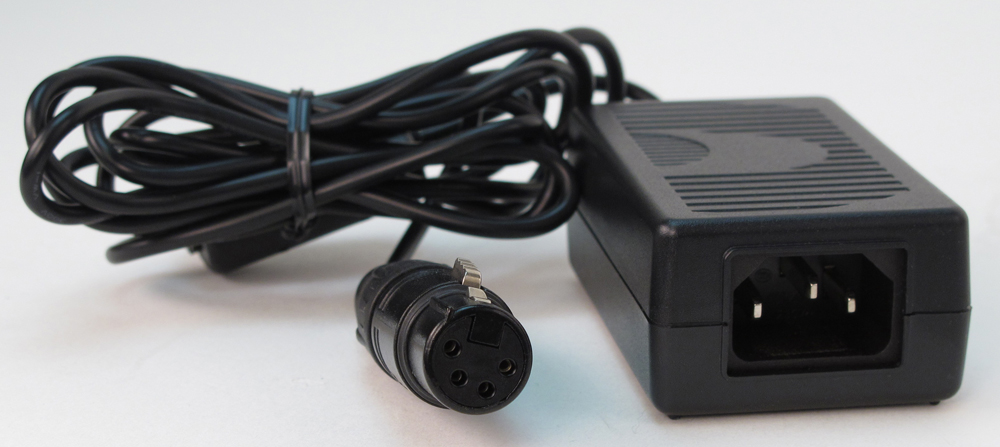
The Model 5422 allows an AC mains source of 100-240 V, 50/60 Hz to be directly connected. It can also be powered using a 10-18 volts DC source that is connected via a broadcast-standard 4-pin XLR connector. If both AC and DC power sources are connected to a Model 5422 the unit will be powered by the AC mains supply. Only if the AC mains source fails will a load be placed on the DC source. This allows a source of DC, typically a battery pack, to serve in a backup capacity. With this arrangement normal operation can continue even if AC mains power is lost.
Updating & Future Capabilities
Updating of the Model 5422's operating software can be performed using the unit's integrated FTP (file-transfer protocol) client. The unit's program software files and configuration parameters are stored in non-volatile memory. (Please note that while FTP can be a very convenient file transfer method, it does require that the Model 5422's management Ethernet connection have internet access. A "firewall" device associated with a LAN can often restrict FTP operation unless a specific configuration is enabled.) The unit's Dante firmware can be easily updated using the Dante Updater application that is included with the Dante Controller application.