Announcements
[hsas-shortcode speed="30" direction="left" gap="120"]

Model 385 Mic/Intercom Beltpack

Order Code: M385 (found on the Dante Products price list)

The Model 385 is a portable user device that combines a high-performance microphone preamplifier and a 1-talk/2-listen intercom interface. Units utilize Dante® audio-over-Ethernet technology. A 5-pin female XLR connector supports single- and dual-channel headsets. The STcontroller application is used for configuration. The unit requires an Ethernet with Power over Ethernet (PoE) connection to supply both data as well as power. The Model 385 is housed in a lightweight enclosure with belt clip.


Click to expand and read more...

Key Features

  • Ideal for use with parabolic microphone and boom pole applications
  • Dante audio-over-Ethernet technology
  • High-performance mic preamp with selectable gain, P48 power, and digitally controlled analog limiter
  • Intercom support with one talk and two listen channels
  • Flexible headphone monitoring with sidetone
  • Excellent audio quality
  • Standard XLR mic and headset connectors
  • AES67 and Dante Domain Manager (DDM) support
  • Power over Ethernet (PoE) powered
  • Uses STcontroller for configuration

Documentation Where to Buy

The Model 385 Mic/Intercom Beltpack combines a high-performance microphone preamplifier with a 1-talk/2-listen intercom interface. It is designed specifically for use by audio personnel who operate parabolic microphones, boom poles, or other specialized microphones to gather audio content for broadcast and live-event applications. Housed in a convenient beltpack form-factor, the lightweight unit supports the Dante audio-over-Ethernet standard and is powered by Power over Ethernet (PoE). The portable Model 385 offers a unique combination of on-air microphone and intercom audio resources. Supporting Dante audio-over-Ethernet networking, it allows direct integration into contemporary fixed and mobile broadcast environments. With the inherent interoperability of Dante, the Model 385 can be used with other Studio Technologies’ Dante-enabled products or a multitude of devices from many other manufacturers. For maximum flexibility, the Model 385 is compatible with the Dante Domain Manager™ (DDM) software application and is AES67-compliant.

Using a standard 3-pin XLR connector, a dynamic or condenser microphone can be connected to the Model 385’s main microphone input. To support condenser microphones, a P48 phantom power source can be enabled. A low-noise, low-distortion microphone preamplifier circuit offers adjustable gain over a range of 19 to 64 dB in 3-dB steps. The analog audio from the preamplifier is converted to 24-bit digital and then output by way of a Dante digital-audio transmitter (output) channel. If enabled, a digitally controlled analog limiter function will help control the dynamic range of the signal associated with the connected main microphone.

A broadcast headset can be connected using a 5-pin XLR connector. The input circuitry for the headset’s microphone offers adjustable gain, as well as a source of low-voltage (“electret”) DC power. The output of the headset’s microphone preamplifier is sent out a second Dante transmitter (output) channel in response to the action of a pushbutton switch. This serves as the intercom talk channel and can be integrated with other Dante-enabled intercom beltpacks and related devices.

Up to four audio sources can be combined (“mixed”), then routed to the headset’s 2-channel headphone output. Three “push-in/push-out” (“pop-out”) rotary controls allow a user to adjust the listen levels associated with the output of the main microphone preamplifier and the audio signals that arrive by way of the unit’s two Dante receiver (input) channels. These audio signals are typically associated with intercom or other Dante-supporting audio equipment. It would be typical for one intercom and one program audio source to be supplied to the Model 385.

The fourth “listen” source is audio from the headset’s microphone preamplifier. This is referred to as sidetone and can be sent, at a fixed level, to the headset’s headphone outputs as a user confirmation signal. The ability of the user to create a custom headphone mix helps to ensure that they can effectively perform their role in a broadcast production.

The Model 385 is optimized for broadcast sports and live-entertainment events. The unit’s audio quality is excellent, with low distortion, low noise, and high headroom. Careful circuit design and rugged components ensure long-term, reliable operation. Needing only a Power over Ethernet (PoE) connection, a dynamic or phantom-powered microphone, and a single- or dual-ear broadcast headset, the unit is ready for fast “on-air” deployment while maintaining “pro” audio quality and an intuitive user experience. An integral belt clip on the unit’s aluminum enclosure allows convenient placement on the clothing of broadcast personnel.

The STcontroller software application, available free of charge from Studio Technologies, is used for configuring the Model 385's operating parameters, including main microphone preamplifier gain, P48 phantom power on/off, limiter on/off, headset microphone electret power on/off, headset microphone preamp gain, headset headphone signal routing, sidetone operation, and talkback button action. The Model 385 can be used as part of STcontroller's VenueView event monitoring capabilities.

Power Source:
Power over Ethernet (PoE): class 2 (low power, ≤6.49 watts) per IEEE® 802.3af

Network Audio Technology:
Type: Dante audio-over-Ethernet
AES67 Support: yes
Dante Domain Manager (DDM) Support: yes
Bit Depth: up to 24
Sample Rate: 48 and 96 kHz
Number of Transmitter (Output) Channels: 2
Number of Receiver (Input) Channels: 2
Dante Audio Flows: 2 transmitter, 2 receiver

Network Interface:
Type: 100BASE-TX, twisted-pair (UTP) Ethernet, Power over Ethernet (PoE) supported
Data Rate: 100 Mb/s (10 Mb/s and 1000 Mb/s GigE Ethernet not supported)

Main Microphone Input:
Compatibility: dynamic or phantom-powered microphones
Type: analog, electronically balanced, capacitive coupled, with signal present/peak LED
Impedance: 3.6 k ohms, nominal, phantom power off
CMRR: TBD, 20 Hz–20 kHz, 40 dB gain
Gain Range: 20–65 dB, adjustable in 1-dB steps
Frequency Response: 24 Hz–20 kHz, +0/–1 dB, 40 dB gain
Distortion (THD+N): <0.002%, measured at 1 kHz, 40 dB gain, –20 dBu input
Dynamic Range: >112 dB, 40 dB gain, >115 dB at 20 dB gain, A-weighted
EIN: –127 dBu, 22 kHz bandwidth, 65 dB gain, 150 ohms source resistance
Phantom Power: P48 per IEC 61938 standard, 45 volts DC nominal, selectable on/off with status LED

Main Microphone Limiter Function:
Type: digitally controlled analog, selectable on/off
Application: applies only to main microphone input
Threshold: 12 dB above nominal level (–8 dBFS)
Minimum On Time: 30 milliseconds
Maximum Attenuation: 16 dB at 36 dB or greater microphone preamplifier gain

Headset Compatibility: single- or dual-ear broadcast-style with dynamic or electret (low-voltage DC-powered) microphone: pin 1 mic common; pin 2 mic +; pin 3 phones common; pin 4 phones left +; pin 5 phones right +

Headset Microphone Input:
Compatibility: dynamic or electret (low-voltage DC-powered) microphones
Type: unbalanced
Electret Microphone Power: 5 volts DC via 2.49 k resistor, selectable on/off with status LED
Impedance: 720 ohms, nominal, 1 kHz
Gain: 24, 30, 36, 42, or 48 dB, selectable
Frequency Response: 42 Hz–18 kHz, +0/–3 dB
Distortion (THD+N): <0.015%, measured at 1 kHz, 24 dB gain
Dynamic Range: 97 dB of dynamic range

Headset Microphone Compressor Function:
Type: analog, with compressor active LED
Application: applies only to Dante intercom transmitter (output) channel and sidetone audio
Threshold: 2 dB above nominal level (–18 dBFS)
Slope: 2:1

Headset Headphone Output:
Type: 2-channel
Compatibility: intended for connection to dual-channel (stereo) or single-channel (monaural) headsets with nominal impedance of 50 ohms or greater
Maximum Output Voltage: 3.0 Volts RMS, 1 kHz, 150-ohm load
Frequency Response: 20 Hz–20 kHz, +/–1 dB
Distortion (THD+N): <0.015%, measured at 1 kHz, 0 dBu output, 150 ohms load
Dynamic Range: >105 dB, A-weighted

Connectors:
Main Microphone Input: 3-pin female XLR
Headset: 5-pin female XLR
Ethernet: Neutrik NE8FBH etherCON RJ45 jack
USB: type A receptacle (located inside Model 385's enclosure and used only for loading application firmware updates)

Configuration: requires Studio Technologies' STcontroller software application

Environmental:
Operating Temperature: 0–50 degrees C (32–122 degrees F)
Storage Temperature: –40–70 degrees C (–40 to 158 degrees F)
Humidity: 5–95%, non-condensing
Altitude: not characterized

Dimensions (Overall):
3.7 inches wide (9.4 cm)
1.5 inches high (3.8 cm) without belt clip; 1.8 inches (4.6 cm) with belt clip
5.2 inches deep (13.2 cm)

Deployment: intended for portable applications; contains integral belt clip

Weight: 0.7 pounds (0.32 kg)

Specifications and information subject to change without notice.

Documentation

Images  

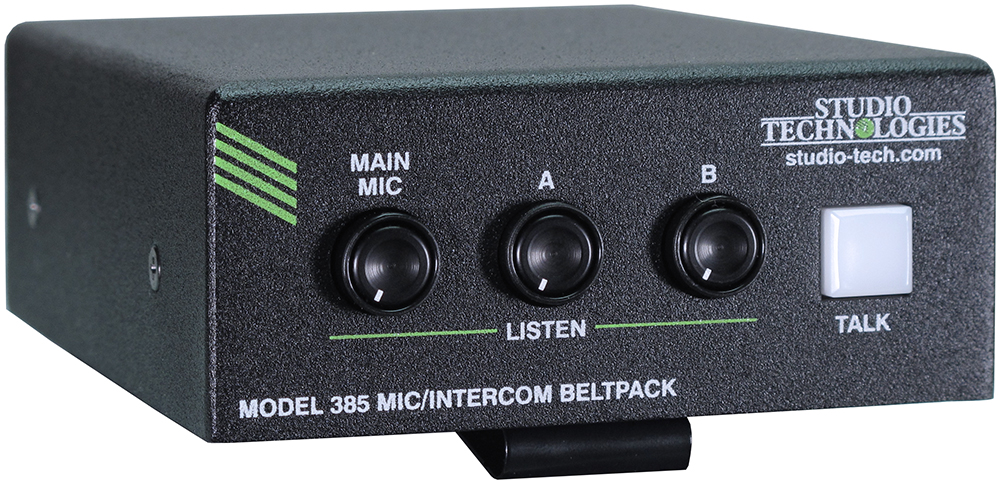
Model 385 Mic/Intercom Beltpack Front Angle View
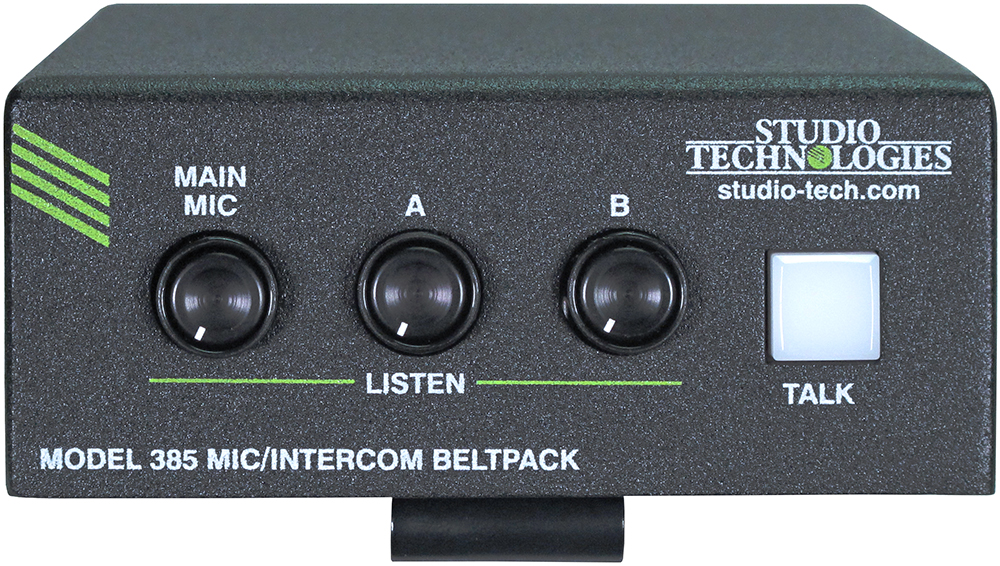
Model 385 Mic/Intercom Beltpack Front View
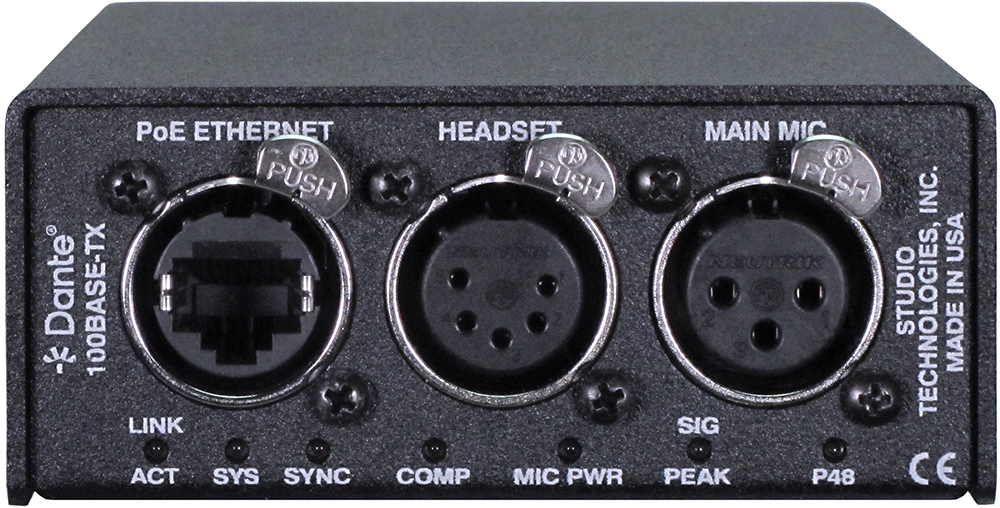
Model 385 Mic/Intercom Beltpack Back View
Menu