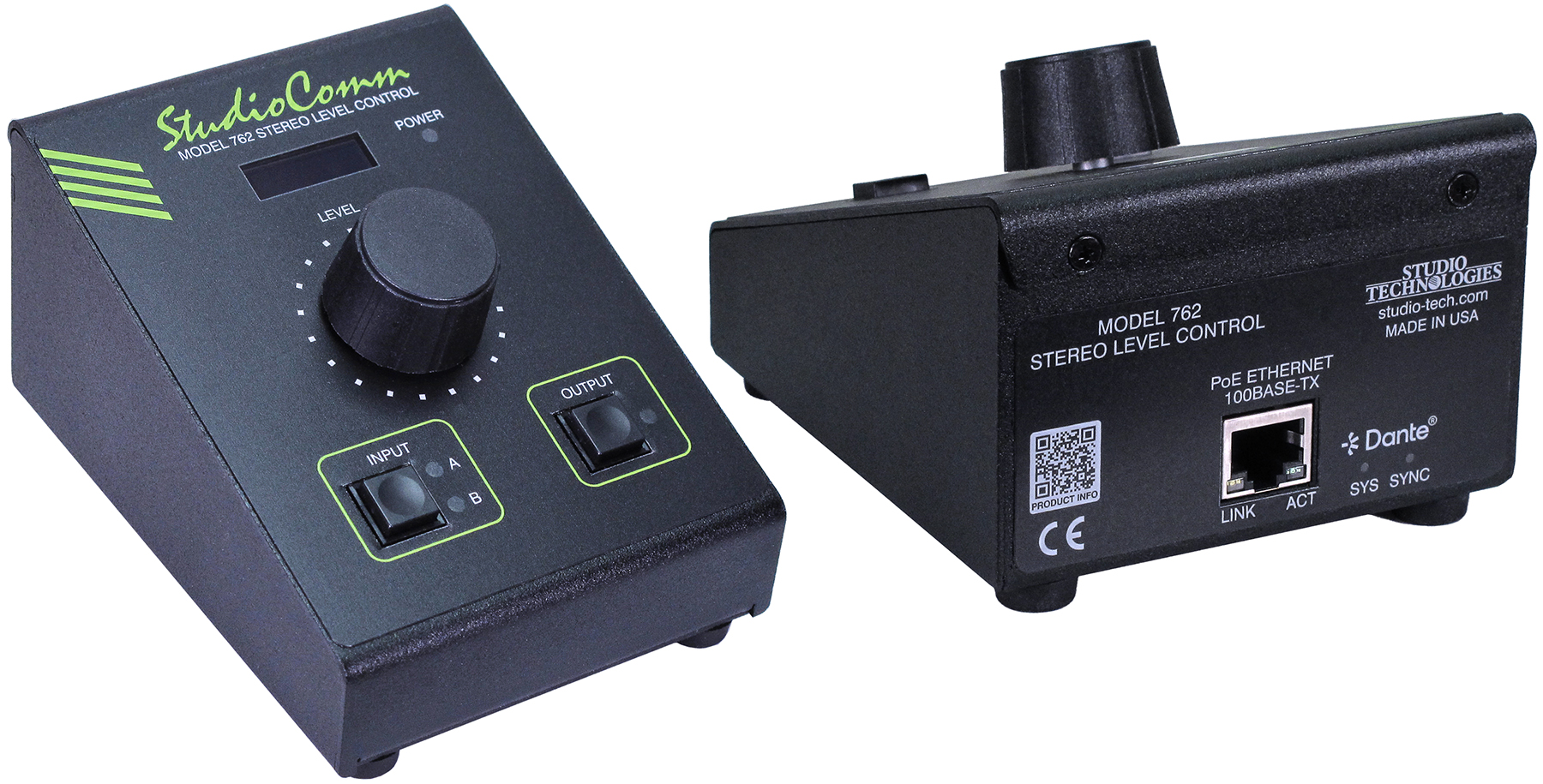
The StudioComm Model 762 Stereo Level Control is designed as a self-contained, stereo (2-channel) monitor control unit for Dante® applications. Its simple design, compact size, and configuration flexibility make it ideal for recording, broadcast, post-production, and general audio applications. It allows monitoring of two stereo (2-channel) sources over one or two stereo (2-channel) Dante-based loudspeaker systems. A configuration choice is specifically provided to allow a headphone cue system to be implemented by connecting a headphone amplifier to the Model 762's second stereo output.
The Model 762 supports Dante audio-over-Ethernet digital media technology with AES67 compatibility for integration into contemporary applications. In addition, the unit is compatible with the Dante Domain Manager™ (DDM) software application. The unit has Dante inputs and outputs. The inputs are intended for connection (Dante subscriptions) to the Dante transmitter (output) channels on broadcast routers, matrix intercom systems, or video editing systems. The Model 762's outputs will be routed to amplifiers or amplified speakers that contact Dante receiver (input) channels. (It is important to note that the Model 762 is an all-digital product and does not contain any analog inputs or outputs.)
The Model 762 is simple to deploy, "pro" quality throughout, and provides an intuitive user experience. The unit's audio quality is excellent, with low distortion, low noise, and ample headroom. Careful circuit design and rugged components ensure long, reliable operation. Only a Power over Ethernet (PoE) connection is required for operation.
Selectable parameters allow the Model 762's functions to be tailored to meet the specific needs of an application. Configured using the STcontroller software application allows a fast and simple means of confirming and revising the unit's operating parameters. The Model 762 is housed in a compact, rugged steel enclosure that's intended for tabletop use. Its small size makes it ideal for applications in space-constrained locations.
Setup, Configuration, and Operation
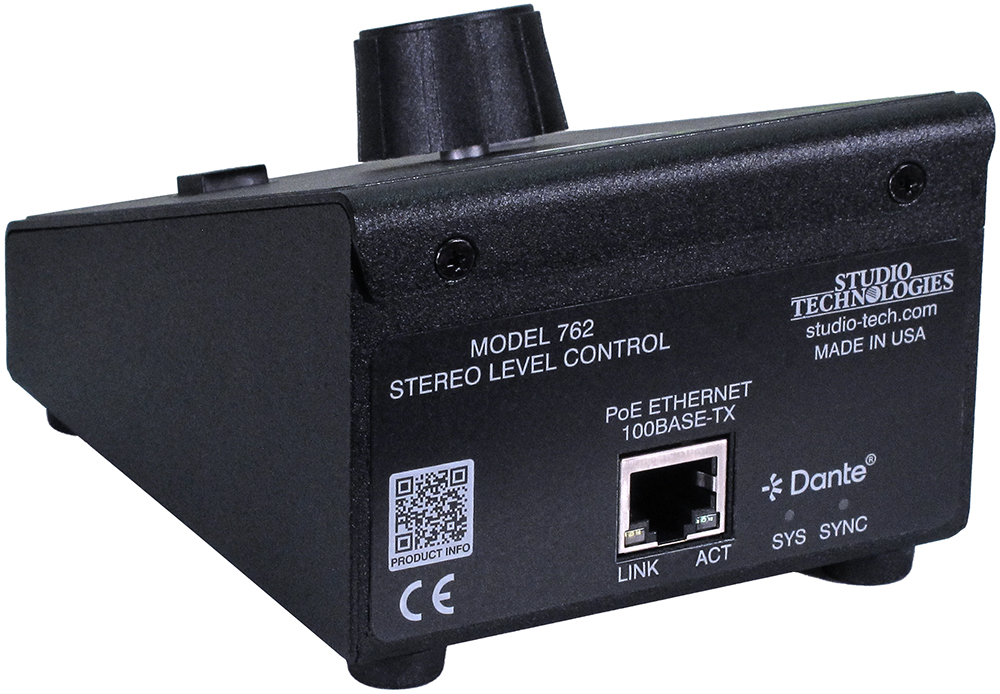
Set up, configuration, and operation of the Model 762 is simple. An RJ45 jack is used to interconnect with a standard twisted-pair Ethernet port associated with a PoE-enabled network switch. This connection provides both power and bidirectional Dante digital audio. The STcontroller software application is used to configure the Model 762's operating parameters. This allows the unit's performance to be optimized to meet the needs of a specific application. The Dante Controller software application is used to route (Dante subscribe) the input and output signals.
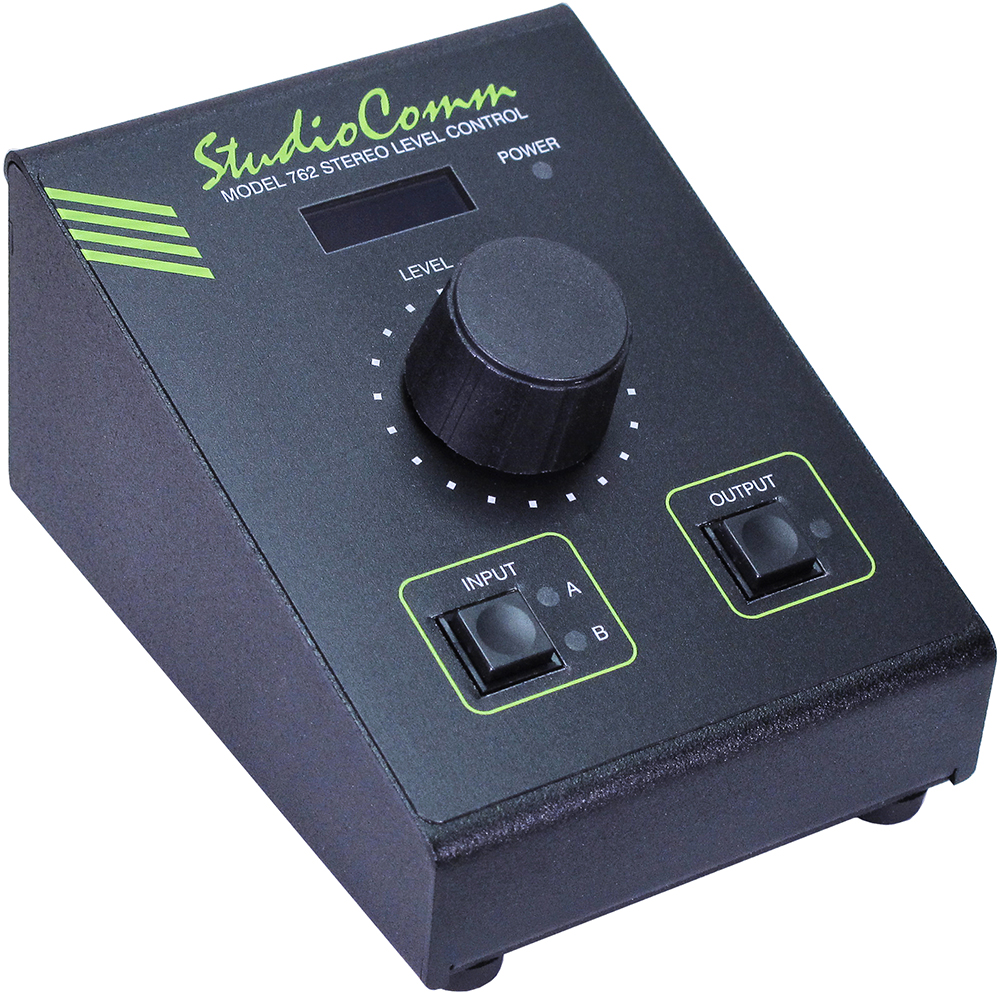
The user is presented with two pushbutton switches, a small digital display, and a rotary encoder. LEDs are associated with the unit's operating power as well as the input and output pushbutton switches. Together they indicate the unit's operating status. The digital display activates during power up, showing the unit's firmware version. During operation, the display will indicate the current output level as well as, by pressing knob associated with the rotary encoder, the IP address of the connected Dante network.
Ethernet Data and PoE
The Model 762 connects to a local area network (LAN) by way of a 100 Mb/s twisted-pair Ethernet interface. The unit's physical 100BASE-TX interconnection is made by way of a standard RJ45 jack. The Model 762's operating power is provided by way of the Ethernet interface using the 802.3af Power over Ethernet (PoE) standard. This allows fast and efficient interconnection with the associated data network. To support PoE power management, the Model 762's PoE interface enumerates (reports) to the power sourcing equipment (PSE) that it's a class 2 (low power) device.
Dante Audio-over-Ethernet
Audio data is sent to and received from the Model 762 using the Dante audio-over-Ethernet media networking technology. As a Dante-compliant device, the Model 762's four Dante receiver (input) channels and four Dante transmitter (output) channels can be assigned (routed or "subscribed") to other devices using the Dante Controller software application. The Dante receiver and transmitter channels support two flows in each direction. The digital audio's bit depth is up to 32 with a sampling rate of 48 kHz. Two bi-color LEDs provide an indication of the Dante connection status. Two other LEDs display the status of the associated Ethernet connection.
The Model 762 is compatible with the AES67 interoperability standard. When configured in Dante Controller to support AES67, the unit's four transmitter (output) channels will function in multicast; unicast is not supported. In addition, the Model 762 is compatible with the Dante Domain Manager (DDM) software application.
Audio Quality
As expected, the Model 762's all-digital design provides excellent audio performance. Stereo (2-channel) audio sources arrive in the Model 762 by way of four Dante receiver (input) channels. The supported sampling rate is 48 kHz with a bit depth of up to 32. The audio sources pass into the Model 762's 32-bit microcontroller integrated circuit where they are routed and level-controlled. The resulting output signals are sent to the Dante interface section where they are packetized and prepared for transport via Ethernet. Of course, for maximum audio quality the signals remain in the digital domain at all times.
Configuration Flexibility
The Model 792 can be configured to meet the needs of specific applications and user preferences. Configuration selections are performed using the STcontroller software application. Versions of STcontroller are available to support the Window® and macOS® operating systems. Selectable configurable parameters include input source selection, output dim (attenuation) value, and output stereo pair B operation.
Future Capabilities and Firmware Updating
The Model 762 was designed so that its capabilities and performance can be enhanced in the future. The unit implements a USB host function which allows the application firmware (embedded software) to be updated using a standard USB flash drive. The Model 762 uses the Audinate UltimoX4™ integrated circuit to implement its Dante interface. Using the Dante Updater application, the firmware in this integrated circuit can be updated via the Ethernet connection, helping to ensure that the unit's capabilities remain up to date.