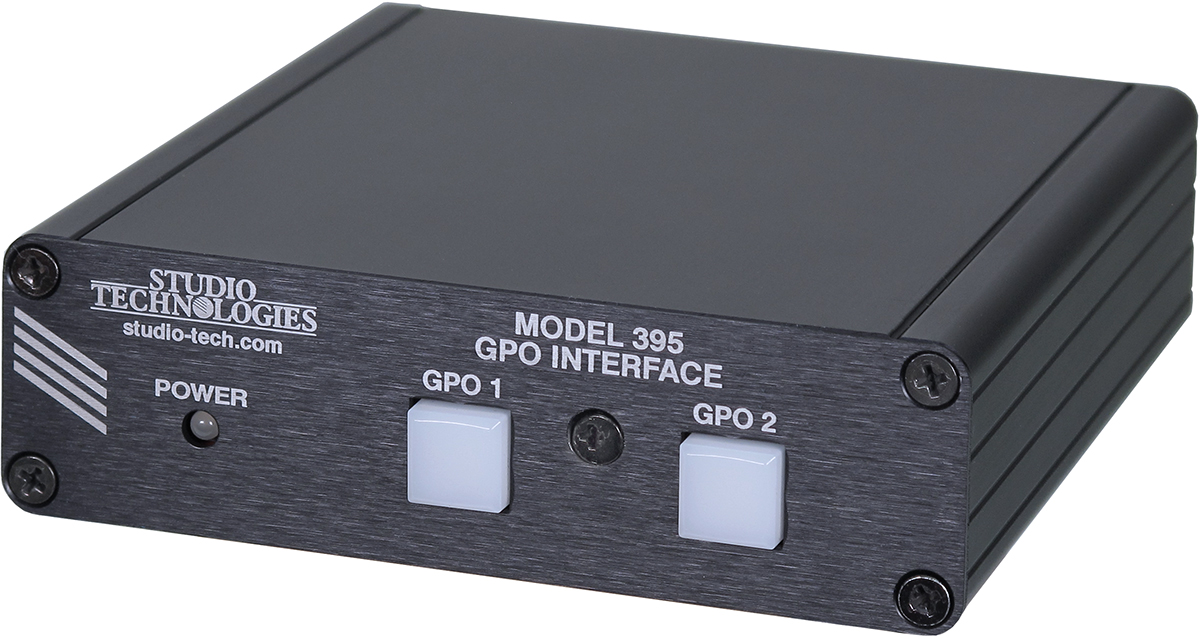
The Model 395 GPO Interface allows two contact closures, computer-generated UDP commands, or virtual pushbutton switches, to be "extended" over an Ethernet network. The unit uses in-band high-frequency audio tones and the Dante® audio-over-Ethernet protocol to transport the control the status of its two GPO functions. Installation is simple and confirmation is easy using the STcontroller software application. The compact, lightweight unit uses the Power over Ethernet (PoE) protocol for its operation power.
Applications
The Model 395 is designed for a variety of applications where the status of a contact closure, user-operated switch, or even a software-generated command from a computer or related device, needs to control a physically separate output. The status of these “source” signals will be transported by way of a standard Ethernet network which can be deployed in a single building, a distributed campus, or even a physically-dispersed installation that utilizes fiber-optic cables. The Model 395's GPO functions recognize "trigger" signals and will then supply interconnected equipment with solid-state signals that either connects to electrical common or supplies a DC voltage output.
The Model 395's GPO functions can be used for broadcast or theater applications where an "on air," "event in progress," or "cue active" status indication needs to be provided in a location separate from the source. It can also find use in industrial applications where the state of a contact closure, or signal generated by a piece of electronic equipment, needs to be transported over an extended distance. As a Dante-supporting device, the status of an input signal can be distributed over an entire associated Ethernet data network. This means that using one or more Model 395 units, the real-time state of an input signal will be available, whether in the same room or on the opposite sides of a university or business campus. There is certainly no reason that the Model 395's "trigger" signals can't be transported literally around the world using audio transport facilities. (Conversion from Dante to the specific type of audio transport would, of course, be required.)
Features
The Model 395 provides two GPO outputs that, depending on the unit's configuration, will function as contact closures or DC outputs. Activating a GPO function can be accomplished using a variety of methods. In most cases, high-frequency tones will arrive via Dante and control the GPO functions. UDP commands can also be utilized. In addition, two pushbutton switches, located on the unit’s front panel, can be used to control the state of the GPO functions. "Virtual" pushbutton switches, provided in the STcontroller application, also allow control of the GPO functions.
Bi-color LEDs are provided within the front-panel pushbutton switches to indicate the real-time status of the GPO functions. Other LEDs provide an indication of the unit's operating status. The STcontroller application supports configuration, monitoring, and control of a Model 395 using a personal computer running the Windows® or Mac® operating systems. The unit's Ethernet connection is used to provide both data and power by way of the Power over Ethernet (PoE) standard. The unit utilizes an extruded-aluminum enclosure that is both lightweight and extremely rugged.
Dante Audio-over-Ethernet
The Model 395 GPO Interface utilizes the capabilities of Dante audio-over-Ethernet media networking technology to transport status indications over standard Ethernet networks. As a Dante-compliant device, the Model 395's two Dante receiver (input) channels can be assigned (routed) to source devices using the Dante Controller software application.
The Model 395 receives GPO status signals using high-frequency audio tones that have a sample rate of 48 kHz and a bit depth of up to 24. These tones are "in-band" (carried within the Dante audio path) and are typically 20 kHz sine wave. The unit receives these high-frequency tones and activates the GPO functions. A number of products from Studio Technologies are also compatible. For example, the Model 348 Intercom Station can generate 20 kHz tones which can be used to trigger Model 395 GPO outputs. Dante-compatible devices from other manufacturers should also be able to be configured to function successfully.
The Model 395 also provides a special "pass through" function. This allows full-bandwidth audio signals that arrive via Dante receiver (input) channels to be passed-through (directly routed at unity gain) to the unit’s Dante transmitter (output) channels.
Ethernet Data and PoE
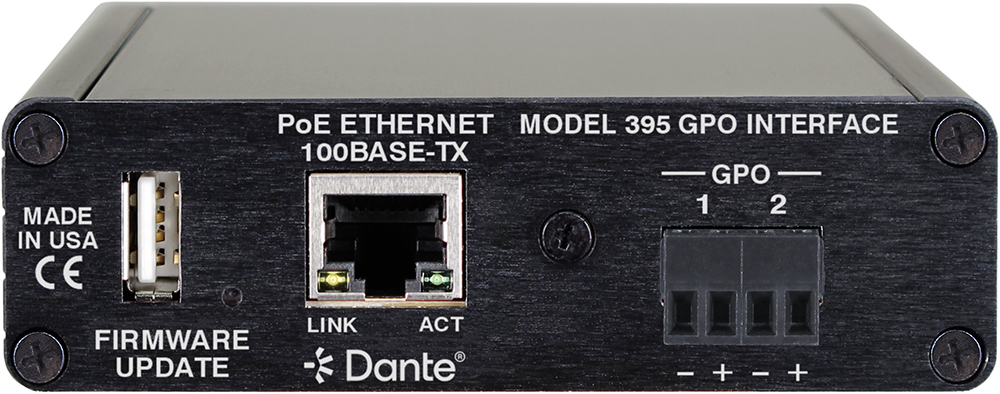
The Model 395 connects to an Ethernet network using a 100 Mb/s twisted-pair (UTP) Ethernet interface. As with all Dante devices, the Model 395 is compatible with standard Ethernet networking equipment. The unit’s physical network interconnection is made by way of an RJ45 jack with support for Auto MDI/MDI-X. Two LEDs, associated with the RJ45 jack, display the status of the network connection.
The Model 395's operating power is provided by way of the Ethernet connection using the IEEE® 802.3af Power over Ethernet (PoE) standard. This allows fast and efficient interconnection with an associated data network. To support PoE power management, the Model 395’s PoE interface reports to the power sourcing equipment (PSE) that it’s a class 2 (low power) device.
Setup, Configuration, and Operation
Setup, configuration, and operation of the Model 395 is simple. An RJ45 jack, located on the unit’s back panel, is used to interconnect, by way of a standard Ethernet patch cable, to a port on a PoE-enabled network switch. This connection provides both network data and power. Two general-purpose (GPO) outputs can be connected to designated destinations using the unit’s 4-position detachable screw terminal block. The two outputs can be individually configured for how they will function when they are active; they can "sink" current (connecting the output to common) or serve as a voltage source that is nominally 3.3 volts DC or 12 volts DC.
The STcontroller personal computer application is used to configure several Model 395 operating parameters. STcontroller, with versions available that are compatible with the Windows and macOS operating systems, provides a fast and simple means of observing and revising the unit's operating parameters. In addition, STcontroller allows the status of the GPO outputs to be monitored using two "virtual" LEDs. These software-controlled pushbutton switches, provided by STcontroller, allow the status of the two GPO functions to be controlled.
In most applications, in-band (contained within the audio path) high-frequency audio signals will be used to control the status of the GPO outputs. UDP commands, presented to the Model 395 by way of the Ethernet interface, allow personal computers and other hardware to control the GPO outputs by way of the Ethernet interface. In addition, two pushbutton switches, located on the unit's front panel, allow control of the GPO functions. These switches can be useful during installation and troubleshooting situations. LEDs within the pushbutton switches provide status indications of the GPO functions, whether controlled by the incoming audio, received UDP commands, the front-panel pushbutton switches, or STcontroller. Other LEDs display the status of the network connection and operating power.
Future Capabilities and Firmware Updating
The Model 395 was designed so that its capabilities and performance can be enhanced in the future. A USB connector, located on the unit's back panel, allows the application firmware (embedded software) to be updated using a USB flash drive. To implement its Dante capability, the Model 395 uses Audinate's UltimoX2™ integrated circuit. The firmware in this integrated circuit can be updated by way of the unit's Ethernet connection, helping to ensure that its Dante capabilities remain up to date.